

Subjects: Early Childhood Education Teaches CTE/ECS/CSP/Psychology
School: Newport High
School Location: Newport, OR
Subject: Computer Science
School: McMinnville High School
Location: McMinnville, Oregon
Subject: Computer Science
School: Hillsboro High School
Location: Hillsboro, OR
What classes do you typically teach and when did you start teaching ECS?
I teach classes in a whole Computer Science pathway, including ECS–which we call creative computing–a web design class, a game design class, and two upper level classes that are dual credit through Portland Community College. I started teaching ECS two years ago and now that class is the foundation of the entire pathway. I am finding a lot of benefit from the course, especially building a classroom community, including my relationships with students and their relationships with each other. It creates a strong foundation for future courses as students find their place in the class, especially when they find people like them.
Throughout the year, we mix and remix the kids for group learning. It’s not the way I’m used to teaching, but oh my is it powerful! They become such a strong community, and they are set to do more computer science. In general computer science students are not always the ones who the social stuff comes easily to. It is worthwhile to make that investment in a learning community.
Please share your ECS story. How did you arrive at this point in your career?
I used to work at Intel, until my second son was born, and I wanted to spend time at home with the kids. Then I became interested in teaching my own kids first. My path actually goes through robotics. I became a coach for First Robotics and discovered I liked teaching, so I got my degree. I became a CTE teacher and also have a traditional teaching license. I started teaching at Hillsboro HS, the location of my robotics club and now my kids’ school. I’ve been teaching for 9 years. I found out about ECS through Jill Hubbard. She advertised there was a grant available, so three of us in our district attended. We have four high schools and three of us have pathways, so we have a nice professional learning community.
I am a big proponent of ECS. I see the difference it makes in my teaching style and the kids’ learning. I’m in a minority/majority school, about 65% Latino, and 100% free & reduced lunch. A lot of times in Computer Science, you plug into the computer; you sit and learn at the computer. That works very well for some people. I find the less computer experience a student has, the less that approach will work for them. If you are trying to reach out to the students not traditionally in the field, including English language learners, it’s less likely that approach will work. It will work for the same people who are already in the field. If you want to diversify, it needs to be more teacher-led.
The teaching style in ECS is very teacher led, as opposed to students plugged into a computer for instruction. Previously, students accessed materials independently, and I was the helper. That’s fine. But if I am not interacting with them, and they are not interacting with each other, then that accessibility is much diminished. By teacher led, I mean there is a lesson plan that comes from me, and it includes my knowledge of the people in the room. Once I made that change to more group work, student discourse, which is so important for English language learners, the success goes up, the diversity goes up. At my school, if we don’t have a diverse class, we don’t have a class. It’s the reason that I teach.
When I worked at Intel and looked at the lack of diversity, I noticed I was one of three women out of 50 people. I tell my students I was a hiring manager, and I never hired a woman or a person of color. They look at me and say, “I thought you were the good guy.” I never had a resume from an underrepresented group, so I never had the opportunity to diversify our workforce. I realized I had to go backwards to fix the problem. The colleges have the same problems. I think we need to fix the problem in the high school, maybe even earlier. We have a diverse population in Hillsboro and I care very deeply about this challenge. The ECS curriculum works very well in this area.
What does equitable CS education mean to you?
It means it is available for everyone, which is the easy part. It means more than that. It requires outreach so when students arrive, they see people like them. You need to build up a cohort. For it to be equitable, everybody has to feel like it belongs to them, they can do it, and they are successful. You have to dig deeper and think about how to make the course accessible to all students.
How do you do recruitment? I spend a lot of time on recruitment, and it’s not an easy answer. I run a big bilingual CTE and STEM summer camp called Si Se Puede for middle schoolers. We have about 4 staff members and 10 high school interns. This is the key–our high school interns teach the camp with the staff as mentors. They get paid. I know that’s hard, but we’ve managed to get funding for it. This will be our 8th year of summer camp. Sometimes it’s been difficult, but we’ve always managed to do it with paid interns. It’s a leadership camp for those students who become even stronger leaders in the high school classroom. I have nontraditional students taking leadership roles.
I also have a robotics club, so the internship serves as an onboarding to that club. It is really great to have an ongoing, year-long after school academic opportunity for students. We recruit from the summer camp into the high school class, also into the robotics club. We also have “CTE Sneaks”, similar to the summer camp, which is a sneak preview of CTE courses. Our student leaders will teach a lesson to middle schoolers in all CTE areas. The student leaders were often the ones in the camp. Kids come back year after year, so it becomes a sustainable system. We built the curriculum with the purpose to be fun, and successful. We pick our best lessons, with the more hands-on activities, the better. We have snacks, we go outside and play soccer during lunch. Teachers get tired and by summer, they are ready for a break. Interns are great! They get paid, they are pretty excited about their summer job, and take on so much responsibility. They have so much young energy which is a key to our success. Otherwise, you are just putting one more thing on the teachers.
When you begin planning a lesson, what is the first thing you think about?
My approach to planning has changed. There’s the old way I taught, and now the new way I teach. It was so important to have done the week-long summer training for ECS because we did the lessons as students. We also created a lesson as a teacher. I look at several things: what we are trying to do, what activities should be group-based, what about teams and student discourse. We start with journal writing, so I think about reflection prompts. I also think about how we will share, such as posters, gallery walks, or presentations. None of that was easy for me at all, and I’m still learning. In the end, I just have to force myself because I always feel like it’s going to fail. I just have to do it. You know, it doesn’t fail. It is a lot of work, but it will be better next year since this is the first year I’ve hit it right on with the good style. I have really bought in and so has the rest of our school district.
What advice would you give to a new ECS teacher?
There’s a lot of diversity in computer science teachers. For me, it was the student discourse that was hard but for others, they have other areas for growth. My main advice is to use the network. There are a lot of us that are doing this and we have ways to communicate. Everyone comes in with strengths and things they are building on, and if we all put it together, then we are all going to be successful. I am lucky that there are 3 of us in our district. We meet quarterly for at least half a day to lay out everything. I am also part of the ECS mentor/mentee program. I have a mentor who is helping me with my areas of struggle. That’s really important too. If I fall back on old habits, then I am not doing the right thing. I see the class being successful, but sometimes you get tired and revert to old habits. I need that support to keep it up, get some new techniques, and keep things fresh. The mentor/mentee program is very powerful as well.
Is there something you have learned (a practice, strategy, or concept) while teaching ECS that has made its way into your other classes?
It’s making its way into all of my classes, which is actually an enormous workload this year, but it is working. I am realizing I need all of my classes to be much more teacher-led, and I need the materials to be much more accessible, I need the students working together and supporting each other more. As the courses get more advanced, less so. Especially if you look at your classroom to find out who is being successful, who is not and why, and don’t just say they have the opportunities, so it’s on them. You have to dig in and look for what is keeping them from accessing the materials. I’ve incorporated learnings from another class on constructing meaning that focuses on good strategies for working with English language learners. The approaches work well together with a teacher-led, community-based curriculum. I’m right there where I need to be. It’s a lot of work, but also a lot of fun.
Describe a really great day in your ECS classroom
This one was so fun. We were doing a lesson focused on computer science pioneers. We had a list of someone either current or in the past who is known for their accomplishments that may have been a little unusual. We had women pioneers, gay pioneers, and others from different demographics. Each student picked a person they connected with for a report. We treated it like a conference where you share learning with colleagues, assuming the role of your person. We had snacks and all, because, “Why not?!” We tried to imagine how people from different places in history might interact given their diverse backgrounds. It was so powerful; everything they learned, the way they presented information and everyone talking. It was easy to teach and the outcome was so rewarding. It was the sort of lesson that for me was a risk. I’m a traditional software person who is an introvert, focused on my computer and my people. It was a great day as students found “their people.”
What do your students enjoy most about their ECS class?
We just finished up the problem solving unit, and I see a lot of kids lighting up as they work through the solutions together. Problem solving is like a game and the light bulb goes off. They like it when something makes sense after they discover solutions instead of a “sit and get” approach.
What is a challenge for you? For me the big risk taking is putting students into groups. I worry they don’t want to talk to each other, and sometimes they don’t. It can be a challenge. I have some students who don’t know English at all, and some students who are selectively mute. We have to make things work, and we do. The challenge is stepping out of my comfort zone in this teaching style and getting that reward. It feels good.
How has teaching ECS affected your own personal and professional growth?
It’s been my goal for a long time to focus on equity and inclusion in the computer science field. When I left Intel, I thought we needed to address the issues in the high school. Now it’s my job as a high school teacher, especially here in Hillsboro, Oregon. The ECS class is the first tool that has really directly supported that goal so well. It has helped me achieve my goal for diversity, where my class looks like my community.
What 3 words (or less) sum up your ECS philosophy, experience, or technique?
– equity, inclusion, and community, which is #1. That may be funny since it’s a computer science class, but we have lots of time for computer science, and we learn it.
Describe a student success story.
I’ve been teaching now for 9 years. One of my very first students, a Latino male, first generation high school graduate, was a sophomore at the time, joined my program. He took a strong interest and helped start the robotics team. I like working with the students. It’s not just that I teach them, but together we are a team. He got a degree in Computer Science at PSU, landed a job in the software industry, and came back to coach software with my robotics team. I have more and more students with that kind of story, first generation, nobody in the family anywhere near the tech field, but they find their love of computer science in my classes. That is what we can do in ECS; we can reach those kids. It can change their lives.
Computer Science and CTE Visual Arts and Communications
Waldport High School
Waldport, OR
What classes do you typically teach and when did you start teaching ECS?
I teach commercial art, computer science, AP art, mixed media, broadcast, video production, and a middle school art class. Our school is a little different with scheduling. There is a two-year cycle where I teach ECS one year, followed by AP Computer Science (CS) principles.
Please share your ECS story. How did you arrive at this point in your career?
I went to school for Art Education and didn’t have a CS background. I was a CTE (Career & Technical Education) art teacher when I first got hired. I liked pushing the envelope using technology in my art classroom, such as 3D printing and laser engraving. I was also the EdTech rep for my building, so when Jill, Deborah and Joanna offered the ECS professional development opportunity, I was interested.
What does equitable CS education mean to you?
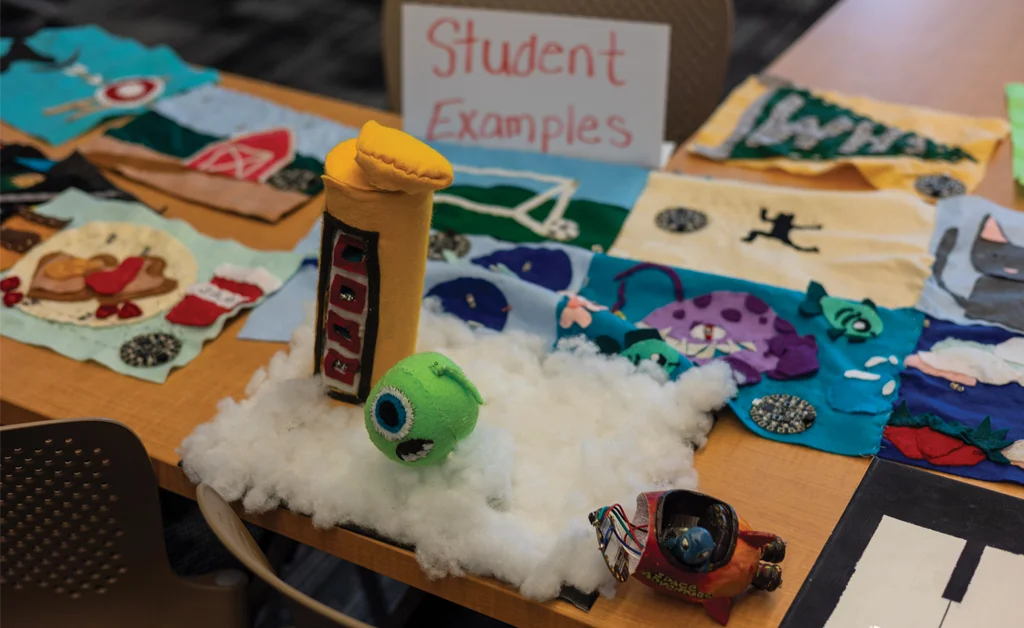
It means meeting students where they are at and pulling back the curtain on computer science by showing them how CS is already in everything they do. I want to show them CS is not some mythical thing for white old men. I love the hands-on nature of the E-Textiles unit with the circuitry design, and aesthetic design. Students who finish early become leaders who help their peers. When you introduce sewing to Computer Science, there’s a big learning curve. When we are doing more traditional programming, the typical leaders are the typical leaders. When I introduce E-Textiles, the leadership structure in the class is often flipped on its head. I love it when those who are strong with traditional programming start asking others for help.
How do you do recruitment?
It’s easy to do at our small school. I am lucky that our district is very supportive of computer science. I also have a strong relationship with our school counselor. We sit down before forecasting to talk about who should be in the class, which helps diversify the program. I also work with the students to encourage them to request the course. We had a huge success with a summer camp experience to generate interest in the program. The ECS curriculum is so approachable that it draws students in who may not sign up for AP Computer Science. I have a 50/50 gender balance in my class this year which is great.
When you begin planning a lesson, what is the first thing you think about?
In that particular class, my students are the first thing I think about. Each year I try to differentiate based on the mix of students in class and go from there. That’s one thing I like about the ECS curriculum – it’s not set in stone, so you can adapt it to meet your students’ needs.
What advice would you give to a new ECS teacher?
Stick with it. Out of all the different subjects I teach, the support network associated with ECS is very strong. There is always a group of people who are there to help you. The network we have among other teachers in the program is so helpful. The way the program is designed with experienced teachers guiding others really makes implementing ECS easier than it might seem at first. If you need help, there’s a whole group ready to help. The typical questions are how to implement a specific lesson given student needs. I am mentoring a teacher who comes from industry, and I helped her adjust a problem solving lesson for her native spanish-speaking population by changing the focus from cornrow braiding to serapes, which are Mexican blankets, to better relate to their culture.
Is there something you have learned (a practice, strategy, or concept) while teaching ECS that has made its way into your other classes?
I feel like a broken record, but I want to return to the E-Textiles unit because I really enjoy that unit and how it’s made. It’s probably the art teacher in me. I use this until with my AP Computer Science class because it’s so hands-on. I like that students make something tangible and program something tangible. In my mixed media classes, we’ve studied art history and the culture behind different techniques such as collage and printmaking.
Describe a really great day in your ECS classroom?
Obviously, student engagement is 100%. I really like to see studio work time after instruction when students are helping other students. I think student engagement is higher in ECS than in my AP Computer Science class. It may be due to the curriculum.
What do your students enjoy most about their ECS class?
I think students really enjoy making the projects to take home. Most CS classes are mainly on screen and ECS has more unplugged (off screen) activities.
What is a challenge for you?
Letting the district and public know what’s going on is a challenge. I try to get students in the spotlight to show off what they are doing. For example, last year students designed apps for our local aquarium. It was really awesome, so we are doing it again this year. (local news story)
How has teaching ECS affected your own personal and professional growth?
My work with ECS has definitely made me a better teacher. There is no set curriculum for any of my art classes, so I am creating it myself. For ECS, I use the teacher resources to build my presentation slides and adapt journal entries as needed. I can spend more time on concepts if needed. I really like the flexibility to meet my students’ needs.
What 3 words (or less) sum up your ECS philosophy, experience, or technique?
Obviously the 3 foundational strands from the program (CS Concepts, Inquiry, Equity). Beyond that, these words come to mind:
– empathy
– clarity (pulling back the curtain of computer science)
– growth
Describe a student success story.
I had a student graduate last year who went into computer science. I had no clue she chose that field, and she ended up winning a computer science award. The fact a student can come in with no knowledge of what 1’s and 0’s mean and end up winning an award speaks for the value of the ECS program.
American Studies, Media and Computer Science West Albany High School Albany, OR
My first license area is in language arts. I teach two sections of American Studies (US History & American Literature) for juniors, two sections of student media (journalism & yearbook), and two sections of computer science. We have a Computer Science 1 course which is ECS (Exploring Computer Science) and we have Computer Science 2, but I don’t teach it every year. This year I have two sections of Computer Science 1. My other class is a stacked advanced class with students enrolled in several different courses: AP Computer Science Principles, Computer Science A–the next course after CS Principles–and CS Practicum, an independent class for seniors where student teams work together on projects.
On our campus, anyone can pitch a course to your department, then the school site council, which is really uncommon. If approved, the course is added to the catalog for students. I had been here a couple of years and I asked my principal why we didn’t offer computer science to students. I thought it was wild that it wasn’t available. She had tried to offer it for years, but didn’t have anyone to teach it. Nobody in math or science was interested. I asked if I could teach it, even though I didn’t know anything about it. We are 15 minutes away from OSU, we have many parents who work in industry and it was mind blowing to me that a comprehensive Oregon high school did not offer computer science at all. If you were a student interested in the field, we didn’t have anything close to help you pursue your interest. With her support, we pitched it and the site council approved.
I had a full class the first year and received the Amazon Future Engineer grant which provided an online curriculum. At first I was thrilled to have a curriculum, but once the year started, it was awful. I cannot stress how awful it was, from a person with 15 years of teaching experience. Maybe it’s perfect in some situations, but the kids I had immediately lost interest. Kids with previous experience found it completely boring and they zoomed through the curriculum because it was so canned. I had kids flee because they were bored out of their minds, and I found myself trying to convince them to stick with it, hoping it would get better. The majority of my teaching was about persistence and getting through frustration. That spring, I went to Jill Hubbard’s session at OCSTA (Oregon Computer Science Teachers Association) where she was modeling a lesson she would teach to students. My mind was blown by the way she was teaching it. Her approach was SO different from the curriculum I had been using. Jill and I met briefly so I could pick her brain about how to engage students in computer science. She invited me to try the ECS curriculum. I attended the virtual summer workshops, and eventually became a facilitator.
Anyone from anywhere with any level of exposure and experience can start at any time. When I taught the first year with the online curriculum, it was not that. Many of the kids left because they felt like there was no way they could be successful. The message they got was, “You can’t do this”, which was the opposite of why I offered this opportunity. I think one of the biggest differences between CS with an equity focus and more traditional approaches is the focus on purpose over tools. The online curriculum I used the first year was heavily focused on the tools. It’s hard because at first, it doesn’t feel purposeful to learn the minute syntax details of one specific programming language. There wasn’t a lot of buy-in for that. Kids love to ask, “when am I going to use this in life?” I think of it like my keyboarding class in high school. You could not move on unless you could reach a certain speed (words per minute). If somebody had rebranded the course to learning how to write better, it would have had more meaning. Typing is a super helpful skill but I don’t go about my day feeling like the act of typing at a certain speed is super purposeful in my life. I think it’s the same way when we start out of the gate with teaching kids to program in Python. When they copy lines of code from a script and it doesn’t work, and the fix is to replace a colon with a semicolon, or use only one equals sign instead of two, doesn’t feel meaningful. I think it takes some convincing before learning the programming language to get students to see the larger purpose. ECS is interesting because it looks both directions: it looks at how computer science is already part of your life, and it opens the door to how it could be. You take a kid who loves art and you can show them how computer science is already impacting this field they love. You can also show them these really cool things that you can do beyond your current skill set. You can multiply your skillset and see many more opportunities with something you love. If the first activity students do in an intro to computer science class is to write a program to perform simple math calculations that add two numbers together, kids ask, “Why have I spent two days doing this? I have a calculator!” It’s not very satisfying and it’s really boring.
It’s hard. This is a current struggle for me because recruiting freshmen is pretty much impossible. The struggle with freshmen year is that band classes can take up multiple periods in a schedule. AP classes also fill student schedules because many of them are singletons, which are only available at particular times. Kids who don’t fill their schedules with AP classes have an easier time fitting in computer science classes. One of my campus struggles is that I am the only CS teacher. We have an introductory elective “wheel” where students get 9-week experiences to explore interests such as music, drama, culinary arts, and child development. Computer science is not part of the wheel so I don’t get the mass exposure to all kids. They have to seek it out on their own. One year I was part of the wheel and my numbers were great – more girls, and more latino students. When I took over the yearbook, I no longer had space to teach in the elective wheel.
My ECS class is primarily for freshmen, although some kids find it later, but forecasting happens within middle school. I teach a class that is equity-focused, but who walks through the door doesn’t reflect the diversity of my campus. Ideally, we’d assign students randomly to get a representative sample, but that’s not how the system works. We tried an 8th grade summer camp and asked for recommendations from science, math and STEM teachers, starting first with invitations to those from underrepresented groups, then opened it up to all. That group of kids is now sophomores and a big chunk of them are in my AP class and they are zooming along, including a handful of girls that may not have enrolled without the camp experience. Conceptually, ECS overlaps AP Computer Science Principles a lot. I have some kids who skip the intro class due to full schedules and enroll because they want AP classes on their schedule. Half of my class are kids who take no other AP classes. For that group, there is a buy-in process where I encourage them to take the class despite their initial reluctance due to perceived challenges (workload, AP test…). When they get to the course, they are surprised by how prepared they are given their ECS foundation. My ECS students are doing great, just as well as the “AP kids” (those who take multiple AP courses). In fact, sometimes the AP kids struggle more because they didn’t take the foundational course.
For the schools that don’t have computer science, the key is to find an enthusiastic teacher who is willing to learn. We are just like the kids, we think we don’t know enough or are qualified to teach it. After the PD, you feel like you can absolutely teach the course. When schools say they can’t afford a full FTE, the winning strategy is to find a teacher to offer one or two sections. I think every kid should take ECS.
The first thing I always think about is where we are in terms of our goals as well as socially and emotionally. We just started the programming unit and I had to think about how I wanted to group kids based on their previous experience. Some kids have lots of experience with Scratch from elementary and middle school, and if I spread those kids out, they end up taking over the inquiry process. This time I clustered them together and that has allowed for there to be a more authentic and open discovery process in the other groups because they don’t have a dominant person. Teaching others can be a great experience for kids who know programming as it forces them to deepen understanding to teach others. I choose groups based on the dynamics of my class, who’s in the room, where are we in the curriculum, how much time do we have left, and what do they need? Sometimes I have a group of kids who didn’t choose the class so then I find myself shifting towards general knowledge that applies to everyone. Some years I have students very interested in the career field, so we explore current job options. I come from a teaching background while others teaching ECS come from the tech industry, and as a result, we bring very different perspectives to our classrooms. I have to make the learning relevant because I don’t think all of my kids will go into computer science as a career, which is the same for my journalism class. I don’t expect all of those students to become professional journalists. I think about the life skills I want students to have. The ECS curriculum speaks to that given the nature of the foundational curriculum.
It depends on the teacher. You have to meet each ECS teacher where they are. We have a colleague who is teaching at a very small school, with maybe 250 students. Her teaching assignment is freshmen ECS and kindergarten. She has no CS background, but the school wants to offer exciting opportunities for students, so she was sent to the summer ECS workshop. The person I’m mentoring right now is from industry, so he has a tendency to focus on specific minute programming details. I often say, “That’s okay, but that’s not the point.” He may hold three or four kids who are already interested in CS with that approach. What about the 14 year old with an IEP who shouts out during class? What is that kid going to get from today? You (ECS instructors) have to differentiate for teachers just like we do for students. I often ask, “What makes your heart sing?” You have to experiment with your own approach within the curriculum. Sometimes we get experienced CS teachers in ECS who are learning how to broaden their approach to reach more kids. It’s hard to un-know things, especially if you have been teaching a particular way for years.
All the time. It’s the professional development (PD) approach to ECS I’m thinking about, not mainly the curriculum. It’s the single best PD I’ve ever done in my career, even the virtual version during Covid. The ECS virtual PD was the model for my virtual teaching in 2020-2021. Everything that I did that year I credit it all to ECS, and by proxy, my school staff that I trained. The frame of inquiry, equity, and computer science can be adapted to any discipline–inquiry, equity, and language arts, inquiry, equity, and science–When you put your content side-by-side on equal footing with inquiry and equity, it forces you to question some of the practices that you may have been doing forever. That frame alone influences all of my teaching. For example, I am constantly thinking about how to give every kid a voice at their table. I can’t say I did that in the 15 years I taught before my ECS experience. My first thought was always on what I was teaching the next day. What do students need to know by the end of the day? Now I think about helping kids consider how to exist in the world as much as any particular discrete skill.
A really great day usually involves a lot of chatter, some laughter, and a little bit of movement, especially since we have 90 min periods. There are lots of kids talking to many different kids, several ah-ha points, and a little bit of writing. Once of my favorite things about ECS vs the canned curriculum I did initially, is the explicit thinking and processing we do, such as how something applies to the world. On a good day of ECS, kids leave not just smarter, but better people, more well rounded, more connected, and feeling a sense of purpose and accomplishment. Some of the lessons set you up for that kind of success. For example, I really love the Muddy City Lesson that is built on an inquiry process. You give them a hypothetical problem, and the focus is on the problem-solving process. What they don’t realize is that it’s really a complex computer science problem called minimal spanning tree. Instead of focusing on solutions, we talk about strategies. Groups swap their strategies and have to solve the problem in that way. It’s hard to get kids to get kids to focus on the process of problem solving, and that’s the focus of the lesson. At that point, you talk about the minimal spanning tree and the various group problem solving processes. Next, you shift to real world conversations where the issue applies, such as network connectivity in different neighborhoods. At the very end, when we look at their efficient solutions, I ask them to consider who is impacted. How can people be impacted by algorithms? What appears to be a mathematical, logical solution can move into conversations about the Starbucks employee who was scheduled to work until midnight and then come back at 4am because of the staffing program built for efficient solutions. What is the impact on that person? The magic of the lesson is the slow unrolling of layers. What starts as a hypothetical problem solving activity becomes a conversation about housing inequity. It’s all in the curriculum.
Depends on the kid. What I’ve heard from kids, and sometimes I hear this when they move on is, “AP is less fun.” I think part of what they enjoy is that it’s not the same every day. They come into the class asking, “What are we doing/learning today?” It’s not a predictable routine of going over homework, learning a new concept, then doing more homework. School can be so repetitive at times. Part of the appeal of ECS is that every day brings something new that’s applicable to their lives. I think they really like the idea that they are learning things most people should know, and most people don’t, such as how the internet works. We start by asking them to explain how it works. The average person has no clue about binary and how the internet works. They feel good about becoming aware of the mind-blowing aspects of computer science. It’s very empowering for them; they feel like they accomplished something important.
My biggest challenge is recruitment. I believe in the curriculum, I believe in the pedagogical approach, but it’s really hard to get the kids in the room who I wish were in the room. I want my class to look like a general population English or Algebra 1 class. I hate that it is not representative of our student body. Freshmen don’t have a ton of options with scheduling. If you are taking a language and you have band, you don’t have space for ECS. The electives offered in middle school tend to drive elective choices. I’ve talked to the child development specialist about this because they want more boys in their program. We want more girls in CS. When you are battling stereotypes and that stereotype bias that is so entrenched, it’s really tricky to get the kids in the room. My numbers are good; my sections are full and they are full of boys. I struggle with how to impact that in a meaningful way. We are not hiring, so we have to recruit people to teach it from our current staff, which I did. Unfortunately, they needed him to teach freshmen science, which is frustrating.
Professionally I struggle being a little like an outsider since I did not come from industry. Most CS teacher gatherings other than ECS also reflect the demographics of the industry. I am in the minority and being female, and non white.
One of my seniors who graduated last year was in my first virtual ECS class. The student stayed home in the spring when students could return to school. I was simultaneously teaching in person and online and it was awful. If students at home needed me, they needed to get my attention through the airpod I was wearing. That didn’t always work. I tried to turn the camera and I often forgot about them. I sent a letter home inviting the student to take AP Computer Science the next year, but that didn’t happen. This student was living with a single mom who stocked shelves at a convenience store and wasn’t planning to go to college. When I asked why she didn’t take the class her sophomore year, she said it was because she didn’t think she could do it. She got the courage to do it her junior year and I discovered this kid flew under the radar of all of our support systems. She had all As and Bs, but only two advanced classes. Senior year, she got into OSU with a full scholarship. Her mom didn’t get past 4th grade. I was a person who had a teacher who changed the trajectory of my life in high school. For that student, her experience was life changing, not just for her, but for her family, and I got to be a part of it. And we were a school that didn’t have computer science. How many schools in Oregon don’t have computer science at all?
Computer Science
Ontario High School
Ontario, OR
What classes do you typically teach and when did you start teaching ECS?
ECS, Game Design, Esport Exploration, E-Textiles & Animation. I went to my first training the summer of 2019 but due to the pandemic 2021 was when I really started teaching it the way it was intended to be taught.
Please share your ECS story. How did you arrive at this point in your career?
My degree is in Elementary Education with an emphasis in reading so I started teaching in elementary school. I tried to implement and use technology every chance I could get. I then had the opportunity to teach Middle school social studies and math where I did several multimedia projects for the school which led to a position teaching computer applications. Loved teaching that and was recruited to a Middle/High school computer position in another district. I was able to obtain my CTE certification to teach in the high school where I taught computer science, computer apps, drones and robotics. I then was moved to a district K-12 position where I taught computer science at all grade levels. K-12 was not my cup of tea so I transferred to Ontario HS. My first year at the school I talked to people about wanting to learn more about computer science because I was using boxed curriculum and felt my knowledge of the subject was like Swiss cheese. There were a lot of holes in my knowledge. I was directed to the summer ECS workshop at OSU-Cascades and that has put me on an amazing path.
What does equitable ECS education mean to you?
A chance for all students to succeed. No matter what the student’s computer science background knowledge is, their abilities, where they are from, what language they speak, whether they are a TAG or SpEd or 504 student, or what socioeconomic status they come from….all have a chance for success.
How do you do recruitment?
I have put together flyers for the counselors to take to the middle school that talk about my classes. I have also talked to the counselors and let them know my classes aren’t just for students that are interested in computer science, they are for anyone. My goal is to work with the middle school and offer some small summer camps. Luckily, I have an amazing STEMHub in my area with people that share my passion that I can lean on.
When you begin planning a lesson, what is the first thing you think about?
What is the best way to show this concept to students? How can I make this relevant to their lives? The last few years I have really had to adjust because we aren’t teaching the same students. ECS works best when voices are heard and discussions are happening. That has been the biggest challenge for what strategy can I use to get them comfortable talking with a peer. Right now that is what is driving my planning.
What advice would you give to a new ECS teacher?
Use your creativity and knowledge of your students and plan your lessons around that. Take little reflective notes for the future. Give yourself some grace and keep going. Take advantage of all the resources available. There are Regional Specialist, possibly other ECS teachers in your area, mentoring opportunities. You aren’t alone on your journey!!!
Is there something you have learned (a practice, strategy, or concept) while teaching ECS that has made its way into your other classes?
To help students become more comfortable talking to a peer or a group of peers in my ECS classes, we talk about making mistakes a lot. Most of the time, they aren’t mistakes, they are looking at something from a different perspective and you might not have all the information or background knowledge needed at the time. Teaching students to ask questions for clarification and be OK making a sharing what they were thinking is something I really try to work into each class.
Describe a really great day in your ECS classroom?
Conversations that I don’t have to constantly prompt or students that are usually really shy teaching or demonstrating to another student how to do something.
What do your students enjoy most about their ECS class?
I think they like the variety of units. Most students can find something of interest throughout the year. They also enjoy hands-on activities like the e-textiles class.
What is a challenge for you?
Getting students to understand this class isn’t just for “smart people” and it isn’t just coding. It is for anyone that wants to learn a little more about the foundational concepts of computer science.
How has teaching ECS affected your own personal and professional growth?
The curriculum offers many opportunities to be creative with how it is taught so as a teacher you can really personalize each lesson to individual class needs which keeps the monotony of using a boxed curriculum at bay. However, even more than that, is the professional network of amazing ECS teachers I have to help when I hit a rut or just need some advice on a lesson or situation. Having that safety net allows me to try new things and take some risks pushing me towards growing my professional toolbelt.
What 3 words (or less) sum up your ECS philosophy, experience, or technique?
Inclusive and enriching
Describe a student success story.
In my e-textiles class I had two students work together on a project. One student didn’t speak any English and the other was further along with his English and their mural was voted the best mural in the class. The student that was further along and more comfortable speaking English became the class expert in the project. Students went to him for everything. If I was busy helping another student, I would just ask him to help and he was on it.