Understanding growth mindset practices in an introductory physical computing classroom: high school students’ engagement with debugging by design activities

Background and Context: While debugging is recognized as an essential practice, for many students, encountering bugs can generate emotional responses such as fear and anxiety that can lead to disengagement and the avoidance of computer programming. Growth mindsets can support perseverance and learning in these situations, yet few studies have investigated how growth mindsets emerge in practice amongst K–12 computing students facing physical computing debugging challenges.
Distributed debugging with electronic textiles: understanding high school student pairs’ problem-solving strategies, practices, and perspectives on repairing physical computing projects
Debugging is a challenging yet understudied practice within recent collaborative K-12 physical computing contexts. We examined think-aloud interviews and reflections of seven high school student pairs who debugged researcher-designed buggy electronic textile projects.
 

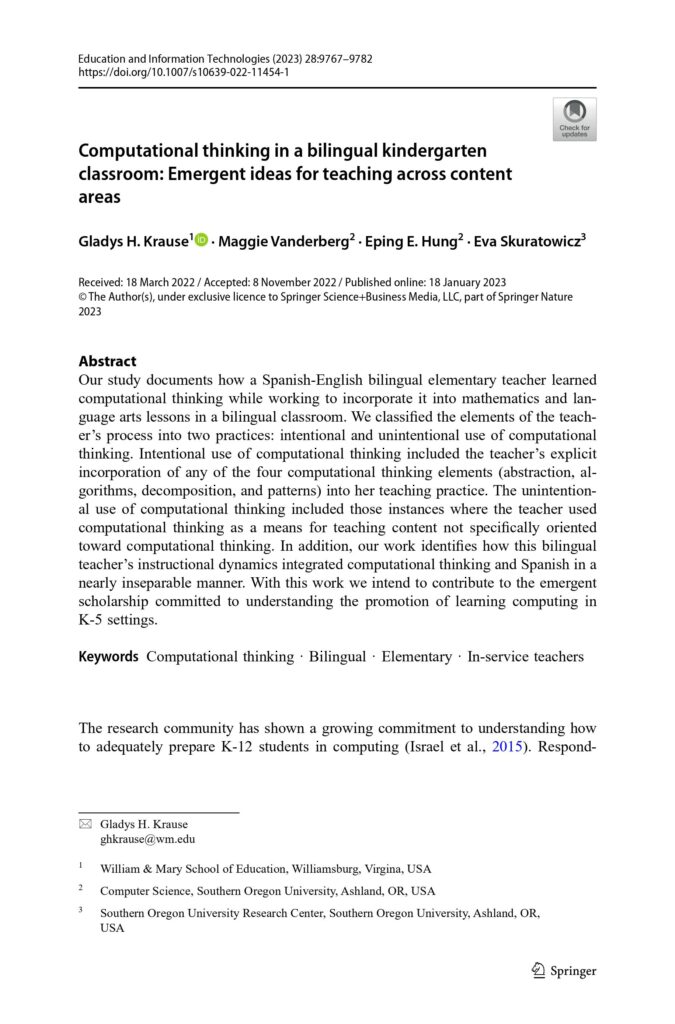
Computational thinking in a bilingual kindergarten classroom: Emergent ideas for teaching across content areas

Abstract: Our study documents how a Spanish-English bilingual elementary teacher learned computational thinking while working to incorporate it into mathematics and language arts lessons in a bilingual classroom. We classified the elements of the teacher’s process into two practices: intentional and unintentional use of computational thinking. Intentional use of computational thinking included the teacher’s explicit incorporation of any of the four computational thinking elements (abstraction, algorithms, decomposition, and patterns) into her teaching practice. The unintentional use of computational thinking included those instances where the teacher used computational thinking as a means for teaching content not specifically oriented toward computational thinking. In addition, our work identifies how this bilingual teacher’s instructional dynamics integrated computational thinking and Spanish in a nearly inseparable manner. With this work we intend to contribute to the emergent scholarship committed to understanding the promotion of learning computing in K-5 settings.
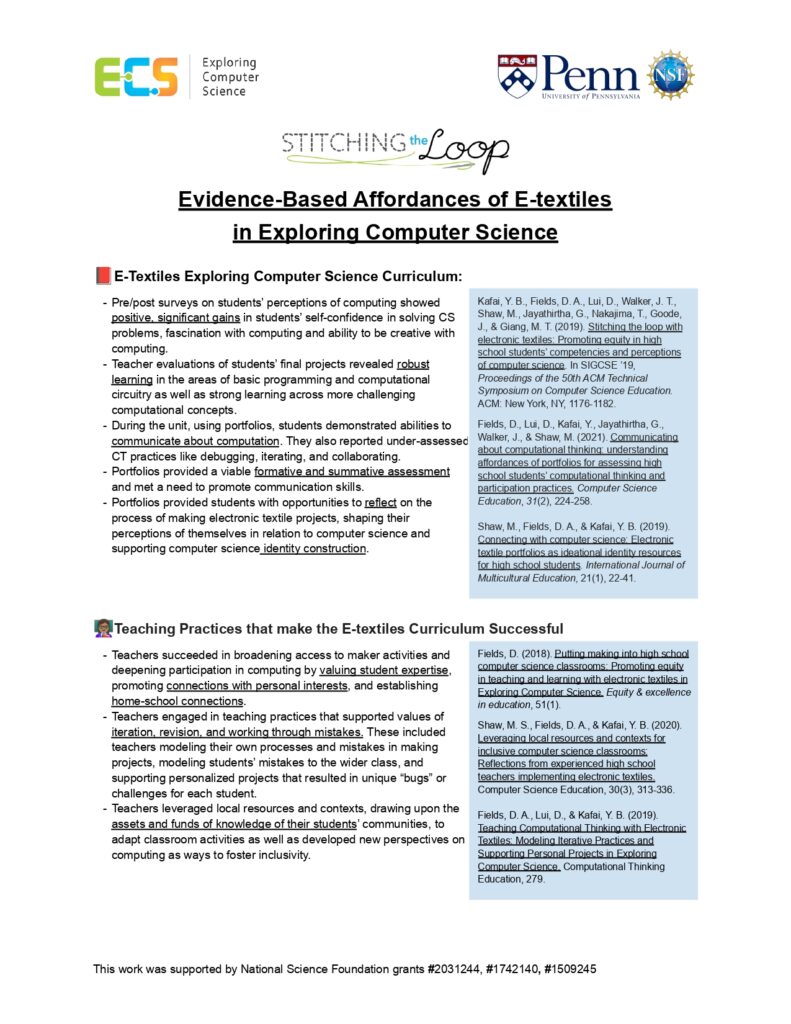
Evidence-Based Affordances of E-textiles in Exploring Computer Science

ECS E-textiles Curriculum Research publication overview: E-Textiles Exploring Computer Science Curriculum Teaching Practices that make the E-textiles Curriculum Successful Debugging & Problem Solving Gains with E-Textiles

Computer Science for Equity: Teacher Education, Agency, and Statewide Reform

This paper reports on a statewide “Computer Science for All” initiative in Oregon that aims to democratize high school computer science and broaden participation in an academic subject that is one of the most segregated disciplines nationwide, in terms of both race and gender. With no statewide policies to support computing instruction, Oregon’s legacy of computer science education has been marked by both low participation and by rates of underrepresented students falling well-below the already dismal national rates. The study outlined in this paper focuses on how teacher education can support educators in developing knowledge and agency, and impacting policies and practices that broaden participation in computing.

Going Beyond the Platitudes of Equity: Developing a Shared Vision for Equity in Computer Science Education

Efforts to broaden participation in computing address how systemic school structures, educator preparation, and curriculum can provide inclusive learning spaces for all students. The emerging multiplicity of scholarship in computer science (CS) education forwards diverse voices, perspectives, and positionalities, and together, provide a rich set of evidence-based narratives that can transform K-12 policies and practices. The four projects featured in this panel bring together CS education efforts with varying methodologies focused on equity-oriented pedagogies and learning for all youth across the US.

Contact Information

Teacher Profile: Corrina Hargett

Subjects: Early Childhood Education Teaches CTE/ECS/CSP/Psychology
School: Newport High
School Location:
Newport, OR

  1. Please share your ECS story. How did you arrive at this point in your career? I was a part-time employee for many years. I started off teaching elementary and special education early in my career, and then I took some time off and raised my family. I did consulting and part-time work before I went back to teaching. I had three little ones in tow with me, so that took me to high school and got me into the CTE program with early childhood education and teaching. For 15 years, I directed a preschool, and did the curriculum for dual credit in the early childhood program of study. Then as my kids got older, I slowly was able to add some more time into my teaching schedule. In 2016, they brought me in full time with my program of study. In 2020, I was one class short of being full time, so they offered me a full time schedule if I did training for computer science. Me and the whole rest of the world said, “What? What are you talking about?” But I did the training with Jill who is so fabulous. She is amazing. I realized I could tap into a lot of my background, which is a lot of problem solving and a lot of collaboration, which is really the skills they were interested in for Exploring Computer Science teachers. I was super shaky and wondered what I was doing in the program. I have had some really amazing kids in my ECS classes. They have taught me a lot. I feel like I’ve been able to learn alongside them. I would credit Jill with being the one that really just helped me feel like I belonged there. 2022-23 was the year I did the e-textiles course in Bend. I’d had shoulder surgery, so I really had to use my brain since I could only use one hand to work on the projects. Jill worked really closely with me, and a lot of light bulbs went on with me as I learned the e-textiles curriculum. I think it was understanding that a program is not going to work if it is not coded correctly or if I miscalculated our sewing. Last year when I actually did the second course, Phillip (fellow district colleague) teased me because I got my wires crossed or something touched and we could smell smoke. He calls me the “fire starter”. This last year was my first year of teaching e-textiles. Many of my students didn’t know how to sew. For some, learning how to sew was one of their big takeaways. They were happy to learn how to do the life skill of threading a needle and doing some stitching. For others, they were able to complete some amazing projects and took them home as gifts for friends or family. Probably the biggest takeaway came as I watched another teacher in my summer eTextiles class go through the experience of overcoming frustration. He was a real whiz of a computer science guy in the class, but was super frustrated when he broke his needle, just like what happens with students. I felt like we were in a regular high school classroom because by the end of the class, he realized he could do it, even though it was hard. It was hard in a different way than the mental thinking about computer science. I think that’s a lot of our students. I will always remember watching those transformations in him. I was in a sling due to shoulder surgery and was having to do things left-handed, so it was hard for me too. That’s the beauty of ECS – really saying you don’t have limitations that are going to stop you from doing something. I feel like I was the poster child. Nobody knows everything, and we all really have to be able to have the opportunities to work together to collaborate and experience different perspectives. I was scared, very, very scared of that curriculum. And now I really embrace it. It had me doing a lot of problem solving on my own as a teacher to work the lessons. I think it also showed me that I can have grace with myself and tell the kids, “You know what, let’s try to figure this out.” I don’t perfectly understand it or know it all. That’s okay. The kids will teach you, and they’ll teach each other.
  2. What does equitable computer science education mean to you? I think it means that anybody that is interested should be able to come into the class and be a part of the class. I don’t think that everybody’s going to learn the exact same things, but it means we’re providing an opportunity for them.
  3. Describe how you collaborate with other ECS teachers and district staff in Lincoln County. The first year when we all did our training together, we worked together with the whole thing. As time has gone on, I think it’s been a little more difficult for all of us to connect often. We did have one meeting last year because we were all working with the dual credit program, but it was really late in the spring. I believe I had a meeting in the fall that had several of the teachers there, but not all of us. There’s the ECS online group that I think we’ve all been able to utilize when I have questions. I feel like the connections I made during that training from people around the state were so strong, and coming back and meeting them face to face again over the summers has been really great. That’s an extended network that is super strong that I could connect with any of the teachers that were in it and be able to to work together.
  4. How do you do student recruitment? Honestly, we really haven’t. I don’t feel like we’ve really recruited kids. I know we do forecasting, but I’m just going to be flat out honest. I think kids either sometimes choose, and then sometimes they just get put in the class. Once they’re put in the class, we try to keep them and hook them, but it seems like it’s changed from year to year. One summer we had some opportunities for kids. I don’t know if there’s a recruitment process that anybody’s been doing in other schools. There may be things that I’m not aware of. Next year my current schedule just has me doing one section of ECS. The class typically has freshmen and sophomores. I think I had a couple of juniors last year, and maybe a senior.
  5. When you begin planning a lesson, what is the first thing you think about? For me, the question is, “Who are my students in front of me?” I’ve had a variety of different students and needs. Who are they and what is their skill set? What are our dynamics within the classroom? Because that plays a really big part in how I design my lessons. I have a favorite example from last year teaching ECS in a class that was mostly freshman boys. I had one special needs student who loved hands-on activities, but getting him to do the journaling and some of the projects wasn’t always easy. The teaching assistant told me this student needed to be doing what all the kids were doing. I just remember one very specific lesson where I pulled out the state of Oregon map. I wanted the kids to find some place that was really remote in Oregon that none of us had heard of. We were using this actual map and they were doing some research, but then I was having them put some pins on the map. We were doing some hands-on work that really interested this one student. It stands out to me because I took him on a college field trip, and he’s probably not a student that’s going to go to college, but he wanted to go on this field trip. And after we were out having lunch, there was a map hanging in this cafe and he pointed out the map. I feel like that was a lesson that we were really able to do something with. It was covering the points that we wanted to cover, but it got all of the kids kind of thinking outside of the box. I was offering extra bonus points if someone can think of a place I haven’t been to, or I hadn’t heard of, because I’ve lived all over the state. There was a lot of discussion on ghost towns and some different things, but I feel like it was a highlight for me because this student was in the middle of the conversation. Kids were gathered around him and they were all engaged, looking at this big state of Oregon map. That’s one of my favorite memories. I would also say that the first year I taught ECS, watching kids collaborate in robotics as they were building ramps was another highlight. I allowed them to take boxes and do some things probably that I would do with early childhood education students where they had to create some slopes and some different things. It was really fun to watch them work together.
  6. What advice would you give to a new ECS teacher? Don’t be a silo. Make sure you talk to people, especially if you feel like you’re stuck or stomped. Don’t just close up and try and do it all on your own; reach out, find the resources. Believe in yourself; really believe in what you know, and remember it’s okay to not know. It’s okay to say to your students, “I want to find that out.”
  7. Is there something you have learned (a practice, strategy, or concept) while teaching ECS that has made its way into your other classes? I love ECS, especially in terms of that whole problem solving piece. I would say all of my classes have an element of research in them. I think specifically for ECS, there was a really old article about the soccer competition when the United States team beat China because they programmed in their penalty kicks. There was something very real about this article, but it was really old, before most of my students were born. I had them take that old article and find something relevant for today. We have a big high school soccer environment. Our teams have been really successful. And what I realized with computer science is that the kids can delve in, do research, analyze information, and debate it. Watching me do that with the ECS class really made me want to have the kids have those opportunities in other classes. Students researched different topics and then brought together their discoveries. It was a way for me to show that although I am the teacher, I don’t have all the information. I asked the students what they could find out and learn. I also teach a psychology class, in which kids have to do research. I feel like some of those lessons from ECS inspired me to trust the kids, and hopefully get them to realize the need to be able to find information, critically think about it, and problem solve it. For example, we have a school garden and I try to make connections to it for all my students. We explored how technology has really improved the agricultural landscape, such as using drones. There’s so much out there. The kids got excited about that because they were going out and seeing these real world problems and how they were being solved with technology.
  8. Describe a really great day in your ECS classroom? I guess my favorite days are when the kids get their heads together working on things collaboratively. They’re showing each other, and they’re teaching each other. They’re teaching me, and you really feel this kind of buzz in the room with what they’re doing. Some of my favorite lessons with ECS are the ones early on where we’re looking at some of the multicultural designs. I feel like that’s one of my strengths, the human connection. I like to shift their focus from games, and help them see connections to the real world. They had so much fun this year making their wristbands and getting the LEDs to light up. The success of that was really fun. Honestly, the frustration part of their learning process is okay too. As a teacher, sometimes we want to fix it and make it better. I let kids really work at threading their own needles and encourage them to do it. I show them how you make a knot. Those little things were really big for the kids. I had them reflect, and some kids said, “You taught me how to sew!” I don’t think we start out with that intent, but that’s a big deal.
  9. What do your students enjoy most about their ECS class? I think they always enjoy a class where they get to be learning with their friends. Sometimes maybe they’re making new friends. I think they also learn their skill set a little bit more – what are you good at? What do you know? I always emphasize that. I ask them to think of four strengths and one skill they are working on. Hopefully they are finding out some of their passions, and what they’re good at. That’s one of my intentions with all my classes is to know who you are, find things you like and don’t like and don’t be afraid to fail. My students enjoy getting to be with each other. This past year in particular, the kids really got a chance to work with younger kids. About six of my students went down to the elementary school and they loved being able to work with the younger kids to do some programming together. They did that as the opportunity for the classroom teacher to be able to pull kids aside for one-on-one.
  10. What is a challenge for you? I feel pretty new to it (computer science). It is one of many preps that I have, so it’s hard to find time to be able to fully prepare for lessons. It’s a challenge to make sure I’m staying just a little bit ahead of the kids. I really want to make sure that I’m providing for everyone. For example, if there’s a student that needs that extra challenge, I want to have something there for them so that they can progress farther along. Assessment and grading can be a challenge, making sure that I am being fair and accurate, while helping kids understand what it takes to learn the material.
  11. How has teaching ECS affected your own personal and professional growth? I think it’s shown me that you can keep learning throughout life. I think teachers are lifelong learners. Technology has been a part of my background, starting out early with special education technology that was very much a part of my college learning. But, not in the ways that I’m using it now or thinking about it now. I think teaching ECS has helped me stretch myself and take risks. I want to recruit more girls because I think the girls really have some unique ways of looking at things. It’s been really fun. I feel like that’s something I need to do to get those kids really excited. I feel like every female that I’ve had in class had strong skills. There are a few that really stood out head and shoulders above the others. I just got done working with one who is a garden intern this summer. We’re building a hoop house and she really has the skillset to look at things mathematically, and to problem solve with others. She is a sophomore and wants to go into engineering. Watching her now in the summer, I just see her persistence and she is a really strong, confident leader.
  12. What 3 words (or less) sum up your ECS philosophy, experience, or technique? The first thing that came to mind was, everyone matters. ECS is fun for everyone. And, you can do it.
  13. Tell me what you think about having a foundational computer science class like ECS for all students? I think it’s great. My concern right now with our curriculum is that we’ve added another requirement this year, another social studies class. I feel like kids are getting less opportunity to do this exploration, and I think they need a lot more exploration. I think they need a lot more hands-on experiences across multiple curriculums. If it’s required, is it becoming a math credit? What kind of credit are they getting? You know what I mean? Because we’ve already mandated so many classes that it feels like they have less and less choice on things. I think it’s great. I think all kids should take early childhood too, as a foundational course. And we’re trying to do some culinary classes. I feel like we have this need for really showing kids just basic tools for life. Technology definitely is there; there’s not a job that doesn’t include the skills that we’re introducing in ECS. So I love the idea. Computer science is not mainly about using a computer. There’s this idea in early childhood called loose parts. It includes giving kids the basic building blocks that you would want children to be able to learn with. That could be rocks and sticks, cardboard boxes, tape…You give them a myriad of choices of things to work with, and then you let them construct. You let them problem solve. I would equate it a little bit to our old fashioned idea of making mud pies, where kids play out in the yard and add water to dirt. It’s giving students those opportunities to explore, and I think computer science is very much that way. I’m just thankful I had this (ECS) opportunity. I did not go out looking for it. It has taught me a lot. I think one of the other things I’ve learned is that there’s a really good career pathway out there for people who want to pursue computer science that’s not necessarily just coding. I think we’re going to all have to learn how AI fits in with the toolbox that we have. Technology is making our world a little easier and maybe quicker than what we used to have to do. Now we have so much information available. How do we find the best information and how to use it? We have to teach them that this is an amazing tool, and then show them how it fits into all the rest of their world.
  14.  

Teacher Profile: Taghrid Elmeligu

Subject: Computer Science
School: McMinnville High School
Location: McMinnville, Oregon

  1. What classes do you typically teach and when did you start teaching ECS? I have a CS pathway. I teach four to six sections of ECS, two sections of Python programming, one section each of C++ programming, CS 160 & CS 161 (both dual college credit classes through Chemeketa). I started teaching ECS eight years ago.
  2. Why should we offer computer science to all students? Computer science touches each and every field of study and jobs right now. Being able to problem solve, to describe your solution, to be able to persist in finding a solution to a problem you are working, all of these are skills essential to success in computer science, but are also transferable to any other field of study or the job market. From my experience, when my younger students learn something in math class, they learn it and it is theoretical for them. But when I am asking them to write a program that uses the same math concepts, it’s a totally different approach for them. Some of them who just did the work to check the box –I learned linear equations – now need to know what is going on so they are able to apply this knowledge in computer science. When we do the robotics unit in my ECS class, the skills of measuring distances and angles are needed to move the robot correctly. These are real life skills and we are giving students a venue to master these skills and then apply them in a different context, which is really important. It’s not about computer science alone, it’s about all of these skills that are required to be successful in computer science and transferable to any other fields of study.
  3. What are the transferable skills your students are building? The idea of breaking a problem down into chunks, figuring out solutions, and being able to describe the solution in detail to somebody else, even if they don’t end up writing the code, is really important. They are learning how to make a plan to solve a problem. Students learn to persevere through a problem, especially when they don’t get a solution the first time, but they want to write the code, so they keep on trying. They have the desire to get the final project done, so they persist with it for a reason that is important for them, not because I am telling them to do an assignment. These skills are essential for our students right now.
  4. Why do you offer a summer camp experience for students? Camps are a way for me to recruit students in a low key, no pressure way. A lot of students do not believe they can learn computer science or enjoy learning computer science. Sometimes parents and counselors encourage students to just try it – give it a week and see what you think. It is a low stakes experience. The majority of students who attend the camp don’t think of themselves as computer science students, but they end up being in my ECS classes. Any way I can give the students an authentic experience of what computer science is – it’s not only about programming and building games – they are concepts that do relate to your life. For example, I offered a four-week camp on Saturdays and each week is something different. One week we focused on physical computing. The students walked a maze and figured out a way through for themselves, then wrote a plan. Students then considered what changes needed to be made to program a robot to go through the maze. We did unplugged activities and then students had a story to complete in Scratch. I gave them a story starter and they completed it with what happened next. Another project was, “Who Am I?” They wrote a program about something that interests them or something they dream to be. I got the kids three hours for each session. One hour was unplugged, related to a computer science concept such as binary, sorting, and searching, just to show students that the way humans think about solving problems is different than a computer. After they solved a problem, I gave them some limitations and asked them to think about how a computer would solve the problem differently. The other two hours the students had a mission to complete with the robot. For example, the robot may be an animal and they have to figure out some of the characteristic behaviors and then model the behaviors with the robot. Each session had a different mission. For example, they may program a rescue vehicle that has to navigate around obstacles to access a cave where people are trapped. I made up stories to make it more interesting.
  5. Please share your ECS story. How did you arrive at this point in your career? When I took over the CS pathway, the entry class was game development class. The students in that class did not accurately represent all the students in my school. I found the ECS curriculum online, and replaced the game development class with the ECS curriculum for a year. Jill Hubbard connected with me and invited me to attend the ECS PD over the summer which opened my eyes to how to teach CS for all students. From there I went on and became a facilitator for the ECS PD and participated in updating the ECS V10 version. Currently, the success of ECS in attracting & retaining students is reflected in the number of students who commit to finishing the Computer science pathway and truly represent all the students in my school.
  6. How do you customize a lesson for the students in your class? In the first unit, we talk about AI, which for my students means mostly ChatGPT. They use it all the time, but they didn’t realize that some of their life decisions might be controlled by AI, like the rate that they are going to pay for the insurance once they get a driver’s license. Later when they apply for a loan or credit card, the rate is going to be determined by AI. I let them research about the current uses of AI and where AI will be when they graduate from high school or from college. We talk about some of the biases in AI. For example, in one activity, we used a simple AI-driven drawing tool and we looked at the data the AI uses to determine what they should draw. We looked at the model of hospitals and found that the majority of the stored pictures to judge hospitals had a cross somewhere in the picture. The students talked about hospitals around the world that were not Christian and why the data had that bias. I want to give them the big ideas that AI has bias in a way they can see for themselves. I am not giving them the answers, but asking them questions to help them explore the answers. When I was playing with the Quick Draw tool, I knew that hospitals in Asia don’t have a cross, they have a crescent, and I could not find a hospital with a crescent. Then I looked at drawing a house. All the houses had pitched roofs, but in countries where it is dry, you won’t have houses with pitched roofs; you have houses with flat roofs. I want them to see that sometimes bias is not intentionally there because somebody is bad, but because the data doesn’t accurately represent each and every user. Why is the data this way? Who is able to access this tool? It is someone with access to the Internet who has the luxury of spending time playing with this tool, which may not be the case for everyone in the world.
  7. What advice would you give to a new ECS teacher? Take it slow. Spend time to really understand both the academic & social objectives of the lesson. Keep notes on how it went the first time to guide your next time teaching the lesson. Reach out to teachers who have been teaching ECS for a while and ask questions. When I started teaching ECS, students thought that computer science was all about coding and writing programs, which is not accurate. When I took over the CS pathway, the capstone was CS 160, which is Introduction to Computer Science for freshmen in college.I could see a mirror chapter by chapter between CS 160 and ECS, but simplified and made more accessible for younger students. That is what sold me on the curriculum when I found it online. 100% I could see it was not frivolous, it is not only for coding. It really exposes the students to the science of computer science.
  8. How do you define Computer Science? Computer science is about solving problems and describing the solution to a computer. You can solve any life problem as a human being, but if you are able to describe the solution and let the computer do the solution for you, the solution will be more efficient and less error-prone because computers don’t get tired, and don’t get bored. But it is a skill. First, you have to understand how to solve the problem. Second, you have to understand the difference between the way we humans think and how a computer is capable of solving problems, and adjust the solution from a human to the way a computer can handle a problem. Finally, comes the programming part when you translate your solution using a programming language. Two-thirds of the process is divorced from the programming part. It is the human thinking part that is really important. The more we have students doing problem solving, the better it is for every field they get into. I like to model this for students by holding a marker and asking a student to hold another marker. We exchange the markers. We both have two hands, and we can do the exchange in one step. But the computer can handle variables only one-at-a-time. So, I ask the student to put one hand behind their back and hold the marker and I do the same. It takes them a while to figure out that one of us has to put the marker down – that’s a variable where you are leaving your marker safe, do the exchange, and then pick up the marker that was put down. That is a limitation because a computer can only handle one variable at a time while us humans can do things in multiple ways. This is a difficult idea for the students to understand, but acting this out helps them understand how a problem must be broken down into basic steps. I made up this example after seeing how students struggled with this concept. Another example is when we start sorting numbers or searching for numbers. I ask students to write a set of numbers on individual pieces of paper and then find the number three. They find it right away. Then I ask them to flip the cards and try to find the three. They are forced to flip the cards one at a time so you are simulating the limitations of the computer. The CPU register has only one place at a time, so you have to look at the numbers one at a time and see how inefficient it is. However, you don’t see the inefficiency because the computer does it really quickly. It is really important to introduce the difference between how humans and computers solve problems.
  9. Is there something you have learned (a practice, strategy, or concept) while teaching ECS that has made its way into your other classes? The advanced CS classes tend to be drier and more focused on programming and I have no leeway to change the curriculum because it’s a CTE program approved by the Oregon Department of Education. For the capstone classes, I have to teach the same materials that they teach at Chemeketa Community College for the students to get college credit. But what I started introducing is the human element of programming. Once the students finish the program, I ask them to think about how they might make it more accessible. For example, I ask students what they might change to make an app menu more accessible for someone who might not have good vision or who is unable to read for whatever reason. I also introduce the ethics of computing whenever possible. Whatever choices students make in their code can be very difficult to change. Coding choices need to be considered very carefully at the planning phases before students write any code. For example, students were creating an app to order pizza with different types of pizza, prices, and toppings. After the first iteration, I asked them to research some of the accessibility features they might add to their program to accommodate somebody who might not know English, or is unable to read the menu on a small screen. They had to pick two or three accessibility issues and figure out solutions. Accessibility is not currently part of the standard curriculum. It seems like most of the time accessibility is added on to programs as an afterthought. A few years ago, my colleague at the community college talked about incorporating ethics of computing into the curriculum. This is a step forward, but I am not sure about accessibility. The courses are CS 160 and CS 161, which are the first two classes students take in college if they plan to major in computer science.
  10. Describe a really great day in your ECS classroom? Everyone is participating to their maximum potential. The bell rings and students feel the class is too short and want to continue talking / working after the bell. For example, while they are dry subjects, my students are fascinated by binary and ascii code. It is so surprising for them that every device they are using really does not understand human language and everything must be translated into zeros and ones. They just eat it up. They really get into understanding how the binary number system works. They often ask, “Can you use this to add numbers?” Yes. When they get into ascii and realize that each and every letter on the keyboard has its code, they are so fascinated that they don’t want to end the unit. They want to learn about related questions, so I share resources and tell them to research. They are really interested and fascinated because a lot of what they see in the media are streams of zeros and ones going across the screen. When they first see it, they have no clue what it means, but after our unit, they understand what they are seeing and how to interpret it. They get really excited. I give them a project where they send a message to their favorite teacher in binary and then they send a translation the following day. The teachers get a kick out of the activity.
  11. What do your students enjoy most about their ECS class? The challenge it offers them and the success in mastering concepts they might have thought too complicated or too difficult to understand. Also, they enjoy the variety of subjects in the curriculum.
  12. What is a challenge for you? Do you have different challenges now than you did when you first started teaching ECS? Tailoring the curriculum to the needs & interests of each student to convince them that they can be successful and can continue studying CS at higher levels. A big chunk of students who did not choose my class, but were maybe convinced by a counselor or had no other choice, are very hesitant about being in the class during the first 2-3 weeks. These students look around the class and see some students know more because they had access to STEM classes in middle school. The students think they are not going to succeed because they didn’t have the same access to courses. It takes about 3-4 weeks for them to see that they can succeed. It does require effort, consistent attendance, and participation in class. They cannot just sit on their hands. Changing the mindset for some of the students. A big majority of them in the first week say, “I’m not sure that I can stay in this class. I’m not smart enough.” It takes a while to convince them that it’s not about being smart. I tell them they are a good student, that their math teacher thinks it is a good fit. It is just that feeling that they don’t belong, are not smart that they must overcome in the first 3-4 weeks. I give them reassurance and tasks they can complete. After two weeks I can say, “See, you did this, you did that…” At the end of the year, I have students write a letter to incoming students to help encourage them to stick with it. I remind them of their insecurities in the beginning and to think about how far they have come. The ones I lose, I simply lose contact with them. In our school, students can change classes after the first two weeks. If I can lock them in during that period, I know given time, I’ll reach them. If I don’t get them during those first two weeks, they will request a change from their counselor, and I don’t see them again, which is sad. If the students attend and are willing to work, I usually get to keep them. We have 2200 students, so it’s a big school.
  13. How has teaching ECS affected your own personal and professional growth? The Community of veteran & new ECS teachers is an amazing resource of new ideas, things to try and an exchange of teaching experiences from teachers coming from different disciplines. I am always changing my lesson plans to incorporate a new idea or a new approach.
  14. What 3 words (or less) sum up your ECS philosophy, experience, or technique? Having each student believe: “You can do it” and support them to get there.
  15. Describe a student success story. A latina senior student joined my ECS class on the recommendation of her counselor and was at first skeptical about her abilities to handle the class. In a letter for future students she wrote :”I enjoyed learning about binary, I thought it would be very difficult but it turned out to be so easy and I wanted to do that for the rest of the time. Through this class I learned to not underestimate myself, I always told myself I was the dumbest in the class, but I left each lesson feeling smarter than before”

Teacher Profile: Terry Alexander

Subject: Computer Science
School: Hillsboro High School
Location: Hillsboro, OR

  1. What classes do you typically teach and when did you start teaching ECS?
    I teach classes in a whole Computer Science pathway, including ECS–which we call creative computing–a web design class, a game design class, and two upper level classes that are dual credit through Portland Community College. I started teaching ECS two years ago and now that class is the foundation of the entire pathway. I am finding a lot of benefit from the course, especially building a classroom community, including my relationships with students and their relationships with each other. It creates a strong foundation for future courses as students find their place in the class, especially when they find people like them.

    Throughout the year, we mix and remix the kids for group learning. It’s not the way I’m used to teaching, but oh my is it powerful! They become such a strong community, and they are set to do more computer science. In general computer science students are not always the ones who the social stuff comes easily to. It is worthwhile to make that investment in a learning community.

  2. Please share your ECS story. How did you arrive at this point in your career?
    I used to work at Intel, until my second son was born, and I wanted to spend time at home with the kids. Then I became interested in teaching my own kids first. My path actually goes through robotics. I became a coach for First Robotics and discovered I liked teaching, so I got my degree. I became a CTE teacher and also have a traditional teaching license. I started teaching at Hillsboro HS, the location of my robotics club and now my kids’ school. I’ve been teaching for 9 years. I found out about ECS through Jill Hubbard. She advertised there was a grant available, so three of us in our district attended. We have four high schools and three of us have pathways, so we have a nice professional learning community.

    I am a big proponent of ECS. I see the difference it makes in my teaching style and the kids’ learning. I’m in a minority/majority school, about 65% Latino, and 100% free & reduced lunch. A lot of times in Computer Science, you plug into the computer; you sit and learn at the computer. That works very well for some people. I find the less computer experience a student has, the less that approach will work for them. If you are trying to reach out to the students not traditionally in the field, including English language learners, it’s less likely that approach will work. It will work for the same people who are already in the field. If you want to diversify, it needs to be more teacher-led.

    The teaching style in ECS is very teacher led, as opposed to students plugged into a computer for instruction. Previously, students accessed materials independently, and I was the helper. That’s fine. But if I am not interacting with them, and they are not interacting with each other, then that accessibility is much diminished. By teacher led, I mean there is a lesson plan that comes from me, and it includes my knowledge of the people in the room. Once I made that change to more group work, student discourse, which is so important for English language learners, the success goes up, the diversity goes up. At my school, if we don’t have a diverse class, we don’t have a class. It’s the reason that I teach.

    When I worked at Intel and looked at the lack of diversity, I noticed I was one of three women out of 50 people. I tell my students I was a hiring manager, and I never hired a woman or a person of color. They look at me and say, “I thought you were the good guy.” I never had a resume from an underrepresented group, so I never had the opportunity to diversify our workforce. I realized I had to go backwards to fix the problem. The colleges have the same problems. I think we need to fix the problem in the high school, maybe even earlier. We have a diverse population in Hillsboro and I care very deeply about this challenge. The ECS curriculum works very well in this area.

  3. What does equitable CS education mean to you?
    It means it is available for everyone, which is the easy part. It means more than that. It requires outreach so when students arrive, they see people like them. You need to build up a cohort. For it to be equitable, everybody has to feel like it belongs to them, they can do it, and they are successful. You have to dig deeper and think about how to make the course accessible to all students.

  4. How do you do recruitment? I spend a lot of time on recruitment, and it’s not an easy answer. I run a big bilingual CTE and STEM summer camp called Si Se Puede for middle schoolers. We have about 4 staff members and 10 high school interns. This is the key–our high school interns teach the camp with the staff as mentors. They get paid. I know that’s hard, but we’ve managed to get funding for it. This will be our 8th year of summer camp. Sometimes it’s been difficult, but we’ve always managed to do it with paid interns. It’s a leadership camp for those students who become even stronger leaders in the high school classroom. I have nontraditional students taking leadership roles.

    I also have a robotics club, so the internship serves as an onboarding to that club. It is really great to have an ongoing, year-long after school academic opportunity for students. We recruit from the summer camp into the high school class, also into the robotics club. We also have “CTE Sneaks”, similar to the summer camp, which is a sneak preview of CTE courses. Our student leaders will teach a lesson to middle schoolers in all CTE areas. The student leaders were often the ones in the camp. Kids come back year after year, so it becomes a sustainable system. We built the curriculum with the purpose to be fun, and successful. We pick our best lessons, with the more hands-on activities, the better. We have snacks, we go outside and play soccer during lunch. Teachers get tired and by summer, they are ready for a break. Interns are great! They get paid, they are pretty excited about their summer job, and take on so much responsibility. They have so much young energy which is a key to our success. Otherwise, you are just putting one more thing on the teachers.

  5. When you begin planning a lesson, what is the first thing you think about?
    My approach to planning has changed. There’s the old way I taught, and now the new way I teach. It was so important to have done the week-long summer training for ECS because we did the lessons as students. We also created a lesson as a teacher. I look at several things: what we are trying to do, what activities should be group-based, what about teams and student discourse. We start with journal writing, so I think about reflection prompts. I also think about how we will share, such as posters, gallery walks, or presentations. None of that was easy for me at all, and I’m still learning. In the end, I just have to force myself because I always feel like it’s going to fail. I just have to do it. You know, it doesn’t fail. It is a lot of work, but it will be better next year since this is the first year I’ve hit it right on with the good style. I have really bought in and so has the rest of our school district.

  6. What advice would you give to a new ECS teacher?
    There’s a lot of diversity in computer science teachers. For me, it was the student discourse that was hard but for others, they have other areas for growth. My main advice is to use the network. There are a lot of us that are doing this and we have ways to communicate. Everyone comes in with strengths and things they are building on, and if we all put it together, then we are all going to be successful. I am lucky that there are 3 of us in our district. We meet quarterly for at least half a day to lay out everything. I am also part of the ECS mentor/mentee program. I have a mentor who is helping me with my areas of struggle. That’s really important too. If I fall back on old habits, then I am not doing the right thing. I see the class being successful, but sometimes you get tired and revert to old habits. I need that support to keep it up, get some new techniques, and keep things fresh. The mentor/mentee program is very powerful as well.

  7. Is there something you have learned (a practice, strategy, or concept) while teaching ECS that has made its way into your other classes?
    It’s making its way into all of my classes, which is actually an enormous workload this year, but it is working. I am realizing I need all of my classes to be much more teacher-led, and I need the materials to be much more accessible, I need the students working together and supporting each other more. As the courses get more advanced, less so. Especially if you look at your classroom to find out who is being successful, who is not and why, and don’t just say they have the opportunities, so it’s on them. You have to dig in and look for what is keeping them from accessing the materials. I’ve incorporated learnings from another class on constructing meaning that focuses on good strategies for working with English language learners. The approaches work well together with a teacher-led, community-based curriculum. I’m right there where I need to be. It’s a lot of work, but also a lot of fun.

  8. Describe a really great day in your ECS classroom
    This one was so fun. We were doing a lesson focused on computer science pioneers. We had a list of someone either current or in the past who is known for their accomplishments that may have been a little unusual. We had women pioneers, gay pioneers, and others from different demographics. Each student picked a person they connected with for a report. We treated it like a conference where you share learning with colleagues, assuming the role of your person. We had snacks and all, because, “Why not?!” We tried to imagine how people from different places in history might interact given their diverse backgrounds. It was so powerful; everything they learned, the way they presented information and everyone talking. It was easy to teach and the outcome was so rewarding. It was the sort of lesson that for me was a risk. I’m a traditional software person who is an introvert, focused on my computer and my people. It was a great day as students found “their people.”

  9. What do your students enjoy most about their ECS class?
    We just finished up the problem solving unit, and I see a lot of kids lighting up as they work through the solutions together. Problem solving is like a game and the light bulb goes off. They like it when something makes sense after they discover solutions instead of a “sit and get” approach.

  10. What is a challenge for you? For me the big risk taking is putting students into groups. I worry they don’t want to talk to each other, and sometimes they don’t. It can be a challenge. I have some students who don’t know English at all, and some students who are selectively mute. We have to make things work, and we do. The challenge is stepping out of my comfort zone in this teaching style and getting that reward. It feels good.

  11. How has teaching ECS affected your own personal and professional growth?
    It’s been my goal for a long time to focus on equity and inclusion in the computer science field. When I left Intel, I thought we needed to address the issues in the high school. Now it’s my job as a high school teacher, especially here in Hillsboro, Oregon. The ECS class is the first tool that has really directly supported that goal so well. It has helped me achieve my goal for diversity, where my class looks like my community.

  12. What 3 words (or less) sum up your ECS philosophy, experience, or technique?
    – equity, inclusion, and community, which is #1. That may be funny since it’s a computer science class, but we have lots of time for computer science, and we learn it.

  13. Describe a student success story.
    I’ve been teaching now for 9 years. One of my very first students, a Latino male, first generation high school graduate, was a sophomore at the time, joined my program. He took a strong interest and helped start the robotics team. I like working with the students. It’s not just that I teach them, but together we are a team. He got a degree in Computer Science at PSU, landed a job in the software industry, and came back to coach software with my robotics team. I have more and more students with that kind of story, first generation, nobody in the family anywhere near the tech field, but they find their love of computer science in my classes. That is what we can do in ECS; we can reach those kids. It can change their lives.

Philip Reed Teacher Profile

Computer Science and CTE Visual Arts and Communications
Waldport High School
Waldport, OR

  1. What classes do you typically teach and when did you start teaching ECS?
    I teach commercial art, computer science, AP art, mixed media, broadcast, video production, and a middle school art class. Our school is a little different with scheduling. There is a two-year cycle where I teach ECS one year, followed by AP Computer Science (CS) principles.

  2. Please share your ECS story. How did you arrive at this point in your career?
    I went to school for Art Education and didn’t have a CS background. I was a CTE (Career & Technical Education) art teacher when I first got hired. I liked pushing the envelope using technology in my art classroom, such as 3D printing and laser engraving. I was also the EdTech rep for my building, so when Jill, Deborah and Joanna offered the ECS professional development opportunity, I was interested.

  3. What does equitable CS education mean to you?
    It means meeting students where they are at and pulling back the curtain on computer science by showing them how CS is already in everything they do. I want to show them CS is not some mythical thing for white old men. I love the hands-on nature of the E-Textiles unit with the circuitry design, and aesthetic design. Students who finish early become leaders who help their peers. When you introduce sewing to Computer Science, there’s a big learning curve. When we are doing more traditional programming, the typical leaders are the typical leaders. When I introduce E-Textiles, the leadership structure in the class is often flipped on its head. I love it when those who are strong with traditional programming start asking others for help.

  4. How do you do recruitment?
    It’s easy to do at our small school. I am lucky that our district is very supportive of computer science. I also have a strong relationship with our school counselor. We sit down before forecasting to talk about who should be in the class, which helps diversify the program. I also work with the students to encourage them to request the course. We had a huge success with a summer camp experience to generate interest in the program. The ECS curriculum is so approachable that it draws students in who may not sign up for AP Computer Science. I have a 50/50 gender balance in my class this year which is great.

  5. When you begin planning a lesson, what is the first thing you think about?
    In that particular class, my students are the first thing I think about. Each year I try to differentiate based on the mix of students in class and go from there. That’s one thing I like about the ECS curriculum – it’s not set in stone, so you can adapt it to meet your students’ needs.

  6. What advice would you give to a new ECS teacher?
    Stick with it. Out of all the different subjects I teach, the support network associated with ECS is very strong. There is always a group of people who are there to help you. The network we have among other teachers in the program is so helpful. The way the program is designed with experienced teachers guiding others really makes implementing ECS easier than it might seem at first. If you need help, there’s a whole group ready to help. The typical questions are how to implement a specific lesson given student needs. I am mentoring a teacher who comes from industry, and I helped her adjust a problem solving lesson for her native spanish-speaking population by changing the focus from cornrow braiding to serapes, which are Mexican blankets, to better relate to their culture.

  7. Is there something you have learned (a practice, strategy, or concept) while teaching ECS that has made its way into your other classes?
    I feel like a broken record, but I want to return to the E-Textiles unit because I really enjoy that unit and how it’s made. It’s probably the art teacher in me. I use this until with my AP Computer Science class because it’s so hands-on. I like that students make something tangible and program something tangible. In my mixed media classes, we’ve studied art history and the culture behind different techniques such as collage and printmaking.

  8. Describe a really great day in your ECS classroom?
    Obviously, student engagement is 100%. I really like to see studio work time after instruction when students are helping other students. I think student engagement is higher in ECS than in my AP Computer Science class. It may be due to the curriculum.

  9. What do your students enjoy most about their ECS class?
    I think students really enjoy making the projects to take home. Most CS classes are mainly on screen and ECS has more unplugged (off screen) activities.

  10. What is a challenge for you?
    Letting the district and public know what’s going on is a challenge. I try to get students in the spotlight to show off what they are doing. For example, last year students designed apps for our local aquarium. It was really awesome, so we are doing it again this year. (local news story)

  11. How has teaching ECS affected your own personal and professional growth?
    My work with ECS has definitely made me a better teacher. There is no set curriculum for any of my art classes, so I am creating it myself. For ECS, I use the teacher resources to build my presentation slides and adapt journal entries as needed. I can spend more time on concepts if needed. I really like the flexibility to meet my students’ needs.

  12. What 3 words (or less) sum up your ECS philosophy, experience, or technique?
    Obviously the 3 foundational strands from the program (CS Concepts, Inquiry, Equity). Beyond that, these words come to mind:
    – empathy
    – clarity (pulling back the curtain of computer science)
    – growth

  13. Describe a student success story.
    I had a student graduate last year who went into computer science. I had no clue she chose that field, and she ended up winning a computer science award. The fact a student can come in with no knowledge of what 1’s and 0’s mean and end up winning an award speaks for the value of the ECS program.

Michelle Balmeo Teacher Profile

American Studies, Media and Computer Science West Albany High School Albany, OR

  1. What classes do you typically teach and when did you start teaching ECS?

    My first license area is in language arts. I teach two sections of American Studies (US History & American Literature) for juniors, two sections of student media (journalism & yearbook), and two sections of computer science. We have a Computer Science 1 course which is ECS (Exploring Computer Science) and we have Computer Science 2, but I don’t teach it every year. This year I have two sections of Computer Science 1. My other class is a stacked advanced class with students enrolled in several different courses: AP Computer Science Principles, Computer Science A–the next course after CS Principles–and CS Practicum, an independent class for seniors where student teams work together on projects.

  2. Please share your ECS story. How did you arrive at this point in your career?

    On our campus, anyone can pitch a course to your department, then the school site council, which is really uncommon. If approved, the course is added to the catalog for students. I had been here a couple of years and I asked my principal why we didn’t offer computer science to students. I thought it was wild that it wasn’t available. She had tried to offer it for years, but didn’t have anyone to teach it. Nobody in math or science was interested. I asked if I could teach it, even though I didn’t know anything about it. We are 15 minutes away from OSU, we have many parents who work in industry and it was mind blowing to me that a comprehensive Oregon high school did not offer computer science at all. If you were a student interested in the field, we didn’t have anything close to help you pursue your interest. With her support, we pitched it and the site council approved.

    I had a full class the first year and received the Amazon Future Engineer grant which provided an online curriculum. At first I was thrilled to have a curriculum, but once the year started, it was awful. I cannot stress how awful it was, from a person with 15 years of teaching experience. Maybe it’s perfect in some situations, but the kids I had immediately lost interest. Kids with previous experience found it completely boring and they zoomed through the curriculum because it was so canned. I had kids flee because they were bored out of their minds, and I found myself trying to convince them to stick with it, hoping it would get better. The majority of my teaching was about persistence and getting through frustration. That spring, I went to Jill Hubbard’s session at OCSTA (Oregon Computer Science Teachers Association) where she was modeling a lesson she would teach to students. My mind was blown by the way she was teaching it. Her approach was SO different from the curriculum I had been using. Jill and I met briefly so I could pick her brain about how to engage students in computer science. She invited me to try the ECS curriculum. I attended the virtual summer workshops, and eventually became a facilitator.

  3. What does equitable CS education mean to you?

    Anyone from anywhere with any level of exposure and experience can start at any time. When I taught the first year with the online curriculum, it was not that. Many of the kids left because they felt like there was no way they could be successful. The message they got was, “You can’t do this”, which was the opposite of why I offered this opportunity. I think one of the biggest differences between CS with an equity focus and more traditional approaches is the focus on purpose over tools. The online curriculum I used the first year was heavily focused on the tools. It’s hard because at first, it doesn’t feel purposeful to learn the minute syntax details of one specific programming language. There wasn’t a lot of buy-in for that. Kids love to ask, “when am I going to use this in life?” I think of it like my keyboarding class in high school. You could not move on unless you could reach a certain speed (words per minute). If somebody had rebranded the course to learning how to write better, it would have had more meaning. Typing is a super helpful skill but I don’t go about my day feeling like the act of typing at a certain speed is super purposeful in my life. I think it’s the same way when we start out of the gate with teaching kids to program in Python. When they copy lines of code from a script and it doesn’t work, and the fix is to replace a colon with a semicolon, or use only one equals sign instead of two, doesn’t feel meaningful. I think it takes some convincing before learning the programming language to get students to see the larger purpose. ECS is interesting because it looks both directions: it looks at how computer science is already part of your life, and it opens the door to how it could be. You take a kid who loves art and you can show them how computer science is already impacting this field they love. You can also show them these really cool things that you can do beyond your current skill set. You can multiply your skillset and see many more opportunities with something you love. If the first activity students do in an intro to computer science class is to write a program to perform simple math calculations that add two numbers together, kids ask, “Why have I spent two days doing this? I have a calculator!” It’s not very satisfying and it’s really boring.

  4. How do you do recruitment?

    It’s hard. This is a current struggle for me because recruiting freshmen is pretty much impossible. The struggle with freshmen year is that band classes can take up multiple periods in a schedule. AP classes also fill student schedules because many of them are singletons, which are only available at particular times. Kids who don’t fill their schedules with AP classes have an easier time fitting in computer science classes. One of my campus struggles is that I am the only CS teacher. We have an introductory elective “wheel” where students get 9-week experiences to explore interests such as music, drama, culinary arts, and child development. Computer science is not part of the wheel so I don’t get the mass exposure to all kids. They have to seek it out on their own. One year I was part of the wheel and my numbers were great – more girls, and more latino students. When I took over the yearbook, I no longer had space to teach in the elective wheel.

    My ECS class is primarily for freshmen, although some kids find it later, but forecasting happens within middle school. I teach a class that is equity-focused, but who walks through the door doesn’t reflect the diversity of my campus. Ideally, we’d assign students randomly to get a representative sample, but that’s not how the system works. We tried an 8th grade summer camp and asked for recommendations from science, math and STEM teachers, starting first with invitations to those from underrepresented groups, then opened it up to all. That group of kids is now sophomores and a big chunk of them are in my AP class and they are zooming along, including a handful of girls that may not have enrolled without the camp experience. Conceptually, ECS overlaps AP Computer Science Principles a lot. I have some kids who skip the intro class due to full schedules and enroll because they want AP classes on their schedule. Half of my class are kids who take no other AP classes. For that group, there is a buy-in process where I encourage them to take the class despite their initial reluctance due to perceived challenges (workload, AP test…). When they get to the course, they are surprised by how prepared they are given their ECS foundation. My ECS students are doing great, just as well as the “AP kids” (those who take multiple AP courses). In fact, sometimes the AP kids struggle more because they didn’t take the foundational course.

    For the schools that don’t have computer science, the key is to find an enthusiastic teacher who is willing to learn. We are just like the kids, we think we don’t know enough or are qualified to teach it. After the PD, you feel like you can absolutely teach the course. When schools say they can’t afford a full FTE, the winning strategy is to find a teacher to offer one or two sections. I think every kid should take ECS.

  5. When you begin planning a lesson, what is the first thing you think about?

    The first thing I always think about is where we are in terms of our goals as well as socially and emotionally. We just started the programming unit and I had to think about how I wanted to group kids based on their previous experience. Some kids have lots of experience with Scratch from elementary and middle school, and if I spread those kids out, they end up taking over the inquiry process. This time I clustered them together and that has allowed for there to be a more authentic and open discovery process in the other groups because they don’t have a dominant person. Teaching others can be a great experience for kids who know programming as it forces them to deepen understanding to teach others. I choose groups based on the dynamics of my class, who’s in the room, where are we in the curriculum, how much time do we have left, and what do they need? Sometimes I have a group of kids who didn’t choose the class so then I find myself shifting towards general knowledge that applies to everyone. Some years I have students very interested in the career field, so we explore current job options. I come from a teaching background while others teaching ECS come from the tech industry, and as a result, we bring very different perspectives to our classrooms. I have to make the learning relevant because I don’t think all of my kids will go into computer science as a career, which is the same for my journalism class. I don’t expect all of those students to become professional journalists. I think about the life skills I want students to have. The ECS curriculum speaks to that given the nature of the foundational curriculum.

  6. What advice would you give to a new ECS teacher?

    It depends on the teacher. You have to meet each ECS teacher where they are. We have a colleague who is teaching at a very small school, with maybe 250 students. Her teaching assignment is freshmen ECS and kindergarten. She has no CS background, but the school wants to offer exciting opportunities for students, so she was sent to the summer ECS workshop. The person I’m mentoring right now is from industry, so he has a tendency to focus on specific minute programming details. I often say, “That’s okay, but that’s not the point.” He may hold three or four kids who are already interested in CS with that approach. What about the 14 year old with an IEP who shouts out during class? What is that kid going to get from today? You (ECS instructors) have to differentiate for teachers just like we do for students. I often ask, “What makes your heart sing?” You have to experiment with your own approach within the curriculum. Sometimes we get experienced CS teachers in ECS who are learning how to broaden their approach to reach more kids. It’s hard to un-know things, especially if you have been teaching a particular way for years.

  7. Is there something you have learned (a practice, strategy, or concept) while teaching ECS that has made its way into your other classes?

    All the time. It’s the professional development (PD) approach to ECS I’m thinking about, not mainly the curriculum. It’s the single best PD I’ve ever done in my career, even the virtual version during Covid. The ECS virtual PD was the model for my virtual teaching in 2020-2021. Everything that I did that year I credit it all to ECS, and by proxy, my school staff that I trained. The frame of inquiry, equity, and computer science can be adapted to any discipline–inquiry, equity, and language arts, inquiry, equity, and science–When you put your content side-by-side on equal footing with inquiry and equity, it forces you to question some of the practices that you may have been doing forever. That frame alone influences all of my teaching. For example, I am constantly thinking about how to give every kid a voice at their table. I can’t say I did that in the 15 years I taught before my ECS experience. My first thought was always on what I was teaching the next day. What do students need to know by the end of the day? Now I think about helping kids consider how to exist in the world as much as any particular discrete skill.

  8. Describe a really great day in your ECS classroom?

    A really great day usually involves a lot of chatter, some laughter, and a little bit of movement, especially since we have 90 min periods. There are lots of kids talking to many different kids, several ah-ha points, and a little bit of writing. Once of my favorite things about ECS vs the canned curriculum I did initially, is the explicit thinking and processing we do, such as how something applies to the world. On a good day of ECS, kids leave not just smarter, but better people, more well rounded, more connected, and feeling a sense of purpose and accomplishment. Some of the lessons set you up for that kind of success. For example, I really love the Muddy City Lesson that is built on an inquiry process. You give them a hypothetical problem, and the focus is on the problem-solving process. What they don’t realize is that it’s really a complex computer science problem called minimal spanning tree. Instead of focusing on solutions, we talk about strategies. Groups swap their strategies and have to solve the problem in that way. It’s hard to get kids to get kids to focus on the process of problem solving, and that’s the focus of the lesson. At that point, you talk about the minimal spanning tree and the various group problem solving processes. Next, you shift to real world conversations where the issue applies, such as network connectivity in different neighborhoods. At the very end, when we look at their efficient solutions, I ask them to consider who is impacted. How can people be impacted by algorithms? What appears to be a mathematical, logical solution can move into conversations about the Starbucks employee who was scheduled to work until midnight and then come back at 4am because of the staffing program built for efficient solutions. What is the impact on that person? The magic of the lesson is the slow unrolling of layers. What starts as a hypothetical problem solving activity becomes a conversation about housing inequity. It’s all in the curriculum.

  9. What do your students enjoy most about their ECS class?

    Depends on the kid. What I’ve heard from kids, and sometimes I hear this when they move on is, “AP is less fun.” I think part of what they enjoy is that it’s not the same every day. They come into the class asking, “What are we doing/learning today?” It’s not a predictable routine of going over homework, learning a new concept, then doing more homework. School can be so repetitive at times. Part of the appeal of ECS is that every day brings something new that’s applicable to their lives. I think they really like the idea that they are learning things most people should know, and most people don’t, such as how the internet works. We start by asking them to explain how it works. The average person has no clue about binary and how the internet works. They feel good about becoming aware of the mind-blowing aspects of computer science. It’s very empowering for them; they feel like they accomplished something important.

  10. What is a challenge for you?

    My biggest challenge is recruitment. I believe in the curriculum, I believe in the pedagogical approach, but it’s really hard to get the kids in the room who I wish were in the room. I want my class to look like a general population English or Algebra 1 class. I hate that it is not representative of our student body. Freshmen don’t have a ton of options with scheduling. If you are taking a language and you have band, you don’t have space for ECS. The electives offered in middle school tend to drive elective choices. I’ve talked to the child development specialist about this because they want more boys in their program. We want more girls in CS. When you are battling stereotypes and that stereotype bias that is so entrenched, it’s really tricky to get the kids in the room. My numbers are good; my sections are full and they are full of boys. I struggle with how to impact that in a meaningful way. We are not hiring, so we have to recruit people to teach it from our current staff, which I did. Unfortunately, they needed him to teach freshmen science, which is frustrating.

  11. How has teaching ECS affected your own personal and professional growth?

    Professionally I struggle being a little like an outsider since I did not come from industry. Most CS teacher gatherings other than ECS also reflect the demographics of the industry. I am in the minority and being female, and non white.

  12. What 3 words (or less) sum up your ECS philosophy, experience, or technique?
    1. Challenging
    2. Inspiring
    3. Fulfilling
  13. Describe a student success story.

    One of my seniors who graduated last year was in my first virtual ECS class. The student stayed home in the spring when students could return to school. I was simultaneously teaching in person and online and it was awful. If students at home needed me, they needed to get my attention through the airpod I was wearing. That didn’t always work. I tried to turn the camera and I often forgot about them. I sent a letter home inviting the student to take AP Computer Science the next year, but that didn’t happen. This student was living with a single mom who stocked shelves at a convenience store and wasn’t planning to go to college. When I asked why she didn’t take the class her sophomore year, she said it was because she didn’t think she could do it. She got the courage to do it her junior year and I discovered this kid flew under the radar of all of our support systems. She had all As and Bs, but only two advanced classes. Senior year, she got into OSU with a full scholarship. Her mom didn’t get past 4th grade. I was a person who had a teacher who changed the trajectory of my life in high school. For that student, her experience was life changing, not just for her, but for her family, and I got to be a part of it. And we were a school that didn’t have computer science. How many schools in Oregon don’t have computer science at all?

Jennifer Tuttle Teacher Profile

Computer Science
Ontario High School
Ontario, OR

  1. What classes do you typically teach and when did you start teaching ECS?
    ECS, Game Design, Esport Exploration, E-Textiles & Animation. I went to my first training the summer of 2019 but due to the pandemic 2021 was when I really started teaching it the way it was intended to be taught.

  2. Please share your ECS story. How did you arrive at this point in your career?
    My degree is in Elementary Education with an emphasis in reading so I started teaching in elementary school. I tried to implement and use technology every chance I could get. I then had the opportunity to teach Middle school social studies and math where I did several multimedia projects for the school which led to a position teaching computer applications. Loved teaching that and was recruited to a Middle/High school computer position in another district. I was able to obtain my CTE certification to teach in the high school where I taught computer science, computer apps, drones and robotics. I then was moved to a district K-12 position where I taught computer science at all grade levels. K-12 was not my cup of tea so I transferred to Ontario HS. My first year at the school I talked to people about wanting to learn more about computer science because I was using boxed curriculum and felt my knowledge of the subject was like Swiss cheese. There were a lot of holes in my knowledge. I was directed to the summer ECS workshop at OSU-Cascades and that has put me on an amazing path.

  3. What does equitable ECS education mean to you?
    A chance for all students to succeed. No matter what the student’s computer science background knowledge is, their abilities, where they are from, what language they speak, whether they are a TAG or SpEd or 504 student, or what socioeconomic status they come from….all have a chance for success.

  4. How do you do recruitment?
    I have put together flyers for the counselors to take to the middle school that talk about my classes. I have also talked to the counselors and let them know my classes aren’t just for students that are interested in computer science, they are for anyone. My goal is to work with the middle school and offer some small summer camps. Luckily, I have an amazing STEMHub in my area with people that share my passion that I can lean on.

  5. When you begin planning a lesson, what is the first thing you think about?
    What is the best way to show this concept to students? How can I make this relevant to their lives? The last few years I have really had to adjust because we aren’t teaching the same students. ECS works best when voices are heard and discussions are happening. That has been the biggest challenge for what strategy can I use to get them comfortable talking with a peer. Right now that is what is driving my planning.

  6. What advice would you give to a new ECS teacher?
    Use your creativity and knowledge of your students and plan your lessons around that. Take little reflective notes for the future. Give yourself some grace and keep going. Take advantage of all the resources available. There are Regional Specialist, possibly other ECS teachers in your area, mentoring opportunities. You aren’t alone on your journey!!!

  7. Is there something you have learned (a practice, strategy, or concept) while teaching ECS that has made its way into your other classes?
    To help students become more comfortable talking to a peer or a group of peers in my ECS classes, we talk about making mistakes a lot. Most of the time, they aren’t mistakes, they are looking at something from a different perspective and you might not have all the information or background knowledge needed at the time. Teaching students to ask questions for clarification and be OK making a sharing what they were thinking is something I really try to work into each class.

  8. Describe a really great day in your ECS classroom?
    Conversations that I don’t have to constantly prompt or students that are usually really shy teaching or demonstrating to another student how to do something.

  9. What do your students enjoy most about their ECS class?
    I think they like the variety of units. Most students can find something of interest throughout the year. They also enjoy hands-on activities like the e-textiles class.

  10. What is a challenge for you?
    Getting students to understand this class isn’t just for “smart people” and it isn’t just coding. It is for anyone that wants to learn a little more about the foundational concepts of computer science.

  11. How has teaching ECS affected your own personal and professional growth?
    The curriculum offers many opportunities to be creative with how it is taught so as a teacher you can really personalize each lesson to individual class needs which keeps the monotony of using a boxed curriculum at bay. However, even more than that, is the professional network of amazing ECS teachers I have to help when I hit a rut or just need some advice on a lesson or situation. Having that safety net allows me to try new things and take some risks pushing me towards growing my professional toolbelt.

  12. What 3 words (or less) sum up your ECS philosophy, experience, or technique?
    Inclusive and enriching

  13. Describe a student success story.
    In my e-textiles class I had two students work together on a project. One student didn’t speak any English and the other was further along with his English and their mural was voted the best mural in the class. The student that was further along and more comfortable speaking English became the class expert in the project. Students went to him for everything. If I was busy helping another student, I would just ask him to help and he was on it.